I recently made a video about making an unattended Windows installer and got flooded with a ton of comments of people asking to switch to Linux or pleading with others to switch to Linux. I’ve wanted to analyze the problems of this for a long time, but more on the biggest issue people have with using Linux.
While the discussion of installation comes up, I don’t think installation is the biggest blocker for people. If people are installing Linux, they are already willing to make a concerted effort to escape Windows. Instead, the problem lies in the experience, not in the applications being bad, but just getting all of your ducks in a row when you first get started.
Today, I want to take a critical examination of the mindset of the people online who beg people to use Linux. I’m avoiding the common arguments like not having the applications you need or hardware issues–this is about the people problem of Linux. Is it standardization? Is it toxicity? You better keep on watching (or reading)!
Installing Is “Fine”
When discussion of Linux comes up, the installation experience is brought up every time. I’d be lying to you if it was straight forward–it’s not. For a lot of people, it’s buying a USB stick, downloading the Raspberry Pi Imager, then flashing your chosen distro to an ISO file.

When I have done this for other people, often times, I am the one supplying the USB stick, because most people don’t have one. They just store all their data in Google Drive or Dropbox, they don’t need a USB stick! On top of that, you have to pick a distro to use and whether that’s even right or not is something people who follow my channel know I have complained about ad nauseam. It doesn’t matter what you pick for our purposes, so I won’t beat that drum to death.
Trafotin’s non-exhaustive distro checklist:
- Must deliver updates when upstream does ASAP.
- Must have secure defaults (e.g. Secure Boot, Wayland)
- Must be run by corporation or community (not a single person)
- Must support some form of rollback (e.g. bootc, BTRFS, etc)
- Must be innovating upstream or changing desktop Linux.
- Must have critical developer mindshare (no BSD).
- Must withstand the wrath of non-technical people.
- Patches security issues within week of issue.
- Package manager must have rollback/redundancy
- Must respect privacy without configuration.
- Must support NVIDIA drivers (as good as they get anyway)
- Must run DaVinci Resolve else you couldn’t read this.
There’s Only So Much That Can Be Done
After finding the appropriate distribution or “distro,” you have to somehow wrangle your Linux ISO file into Raspberry Pi imager and install it to your USB stick. Then you need to backup your data, reboot your computer, then find the boot key to boot into your Linux USB. Now this sounds painful and it certainly is for people especially the first time, but this is actually the best this installation could possibly be.
Replacing the operating system your computer came with is a concerted effort, but it’s not that bad with a bit of knowledge, eve following the occasional YouTube tutorial. While mashing a random key when your computer boots up is pretty annoying, there’s nothing Linux or people who develop for applications for Linux can do. It’s not the best for those not in the know, but it’s the best it can be right now.
A similar comparison is installing a custom Android ROM like GrapheneOS to the Pixel device of choice. GrapheneOS has done virtually everything within their power to work with the constraints of the Android security model and buttons on their website to guide and automate the installation process.
That leaves the actual installation process which you’re bound to find plenty of guides about how to install something like Ubuntu. This is something that Linux app developers can do something about and I think it’s also in a good spot. It’s very clear what you need to and often times you are literally able to mash buttons and complete your installation with little issues. My only major gripe is of most major distributions is full-disk encryption is not recommended out of the box. It should be mandatory on all computers, but Windows/Mac are equally culpable in not enabling it by default too.
Installing Things is a Nightmare

Installing Linux might be a bit cumbersome, let’s get into the real problem–most people will not use Linux because it’s an experience problem. Once you’ve installed Linux and logged in for the first time, getting set up is almost always where problems start to crop up. First off, if you are an NVIDIA user (statistics claim 60% of all desktop computers), you might not even be able to login upon your next update!
Beyond that, it’s installing applications that’s a big problem. You could resort to the packages in your software store, but more than not, they can often break or block updates in the majority of distros (if they even work). You also have to hope that the distro that you chose hasn’t modified the program in a significant way or updates it in a timely fashion.
What’s more there are yearly updates and of all the people I’ve installed Linux on, none of them except one have succeeded in upgrading between major versions without my intervention. I’ve seen this happen on Ubuntu, Fedora, and openSUSE and this is unacceptable.
Even though Windows conceals it, people are still able to move between 24H01 to 24H02 with little issue (even Microsoft has to fumble for months). I’m sure part of this is rooted in the distrust Microsoft has created where people will assume updates break everything, but if you at the people who use things like Debian who stubbornly refuse to update, it’s an example of the fear of updates infecting even the Linux users.

A lot of people who consider themselves part of online Linux circles claim this is because of fragmentation. There’s too many solutions for the same problem. While this is partially true, there’s a reason that will resonate with people better–perfect is the enemy of good.
Many people want their packages to be perfect and we all settle for the same formats and solutions. The problem is many of those formats and solutions are often enumerating problems on top of not proliferating more opposing systems.

How do you download something like Audacity, the audio recorder I use? Well you go to their website and you download the AppImage they provide. The problem is AppImages are inherently broken and require out of date FUSE2 libraries that nobody uses anymore. How can I trust a package provided to me when the method of distribution is creating more problems than it intended to solve?
Things to ignore in online “Linux” circles:
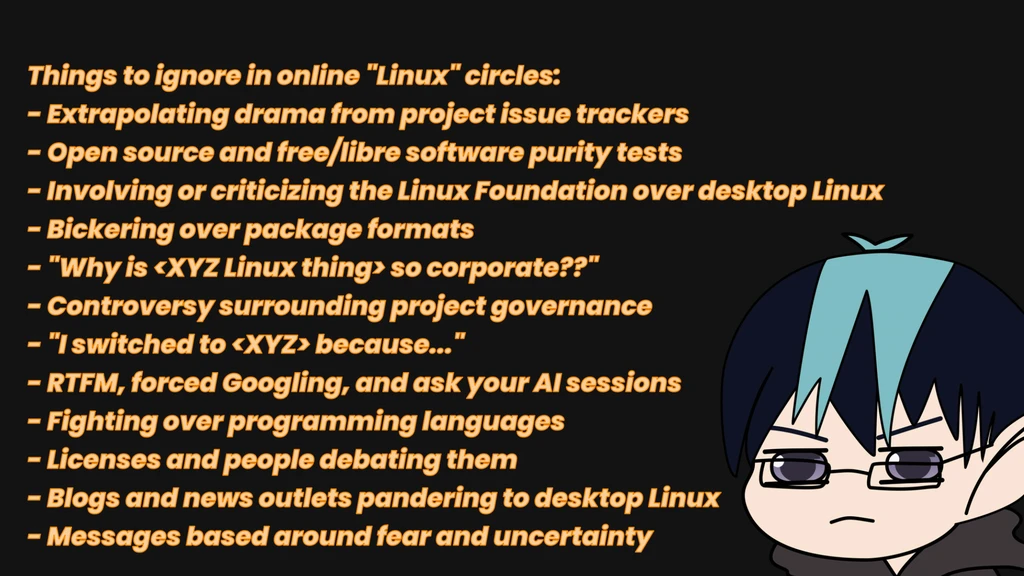
- Extrapolating drama from project issue trackers
- Open source and free/libre software purity tests
- Involving or criticizing the Linux Foundation over desktop Linux
- Bickering over package formats
- “Why is <XYZ Linux thing> so corporate??”
- Controversy surrounding project governance
- “I switched to <XYZ> because…”
- RTFM, forced Googling, and ask your AI sessions
- Fighting over programming languages
- Licenses and people debating them
- Blogs and news outlets pandering to desktop Linux
- Messages based around fear and uncertainty
Linux “Users” Are Not Part of the Linux Community
Why can’t everyone agree on what to use? I think the problem is rooted in the chase over the unicorn of a new Linux user. The experience of desktop Linux is not very good when people have to tell people to Google a solution or read documentation. Desktop Linux will not succeed with a mainstream audience when many parts of it are one developer quitting away from going under.

Using Linux is like being a part of a food pantry. Everybody needs to eat and there’s lots of people who are hungry. There are people who go to get the food they need, but there’s also people who need to bring food to the food pantry so everyone can eat, clean the food pantry so its food that doesn’t go bad, or people to serve the food.
Today, Linux is only at the stage where there’s a lot of people who are hungry, but not enough people to perform the basic functions of developing software. Most distributions can’t even vet their packages or collapse because someone left. But food is still being put on the table and though people might complain, the minority take it the best they can.

What’s a bigger problem to me is the people who serve the food (the Linux users) in the Linux food pantry are too content. They want things to stay the way that it is because they like learning new things and people having the same magical experience they did. They scour the issues pages of projects for juicy gossip and tweak the presentation of the food, but it’s still the same old food the desktop Linux food pantry has been putting out for years.
Most of the people who work at the desktop Linux food pantry do not or have trouble empathizing with people. These are the same people who cosplay as developers when all they did was change some words in a settings file. I was there at one point in my life and I regret it deeply and apologize to everyone who has deal with this side of me. It’s also developers who often make applications just for themselves. Developers in the kitchen and the people being fed need empathy for each other.
Linux Doesn’t Need More Users
 Unpopular opinion: Linux doesn’t need more users. Linux needs people who will make the experience better. Using Linux is not about customization or choice, just like using a food pantry isn’t about the flavors of food; it’s about the food or tool doing its job along with raising a community. Then and only then, can Linux call itself a platform for people to use.
There needs to be more people involved and I’m tired of people online pretending desktop Linux is fine. We’ve seen this over the last couple years and the contrast of behavior to people the “Linux community” has declared did something right and someone who “didn’t get it.” How about both people have valid experiences?
I’m a relatively busy person outside of YouTube and I fear for myself that my own attitude towards the “online Linux user” is getting too bitter. The “online Linux user” is not developers, it’s the people on Reddit showing off their Hyprland configuration. Great drinking game, guess what the comments are when you open a Reddit thread or a YouTube video about what the comments are going to be. That’s how much group think there is in the supposed Linux community and there’s cult-like behavior stopping change.
The real Linux community is the people running the food pantry. It’s not pretty, nor nice to listen to, nor interesting, but it’s the truth. If people are going to spend time complaining about “drama” or “did you hear X thing from this influencer did with Linux,” we have a problem. The only way for this to happen is to bring the money and development power to major desktop Linux projects. It’s time to stop wasting time on customization, packaging applications, or installing Linux. I’ve had enough and users: it’s time for you to actually help out around here.
Related post: Canonical’s Jon Seager announces Ubuntu will replace sudo with sudo-rs
Video References
In order of appearance.
- Katerina Koukiou’s presentation of the new Fedora installer, licensed under Creative Commons Attribution.
- Richard Brown’s FOSDEM 2023 talk: What could go wrong? Me, I was: Containerised Applications are the way, licensed under Creative Commons Attribution.
- Sebastian Wick’s Linux App Summit 2025 talk: The Future of Flatpak
- Aleix Pol Gonzalez, Felipe Borges, Sebastian Wick and Jordan Petridis’s Linux App Summit 2025 panel: The App Ecosystem and the Future of Desktop Linux Distributions
- Pewdiepie: I installed Linux (so should you)
- Matthias Clasen & Florian Leander Singer’s Linux App Summit 2025 talk: GTK apps on Android
- Akademy 2025: KDE e.V. Board - Report of the Board